- Sports 150
- Posts
- Saudi Arabia’s Expanding Sports Infrastructure and Technology Pipeline
Saudi Arabia’s Expanding Sports Infrastructure and Technology Pipeline
Saudi Arabia is undertaking one of the world’s most ambitious sports-infrastructure transformations, positioning the Kingdom as a global hub for elite competition, digital innovation, and year-round fan engagement.

Anchored in Vision 2030, this effort spans a sweeping pipeline of stadium construction, advanced technology deployment, and destination-driven sports districts designed to catalyze economic diversification and community impact.
The scale of development underway is unprecedented. The Kingdom is preparing to host a suite of major global events—spanning motorsports, football, endurance racing, indoor multisport, and winter events—setting the stage for the 2027 AFC Asian Cup and the 2034 FIFA World Cup. These milestones are not only driving demand for new sports venues but also accelerating adoption of next-generation digital stadium technologies.
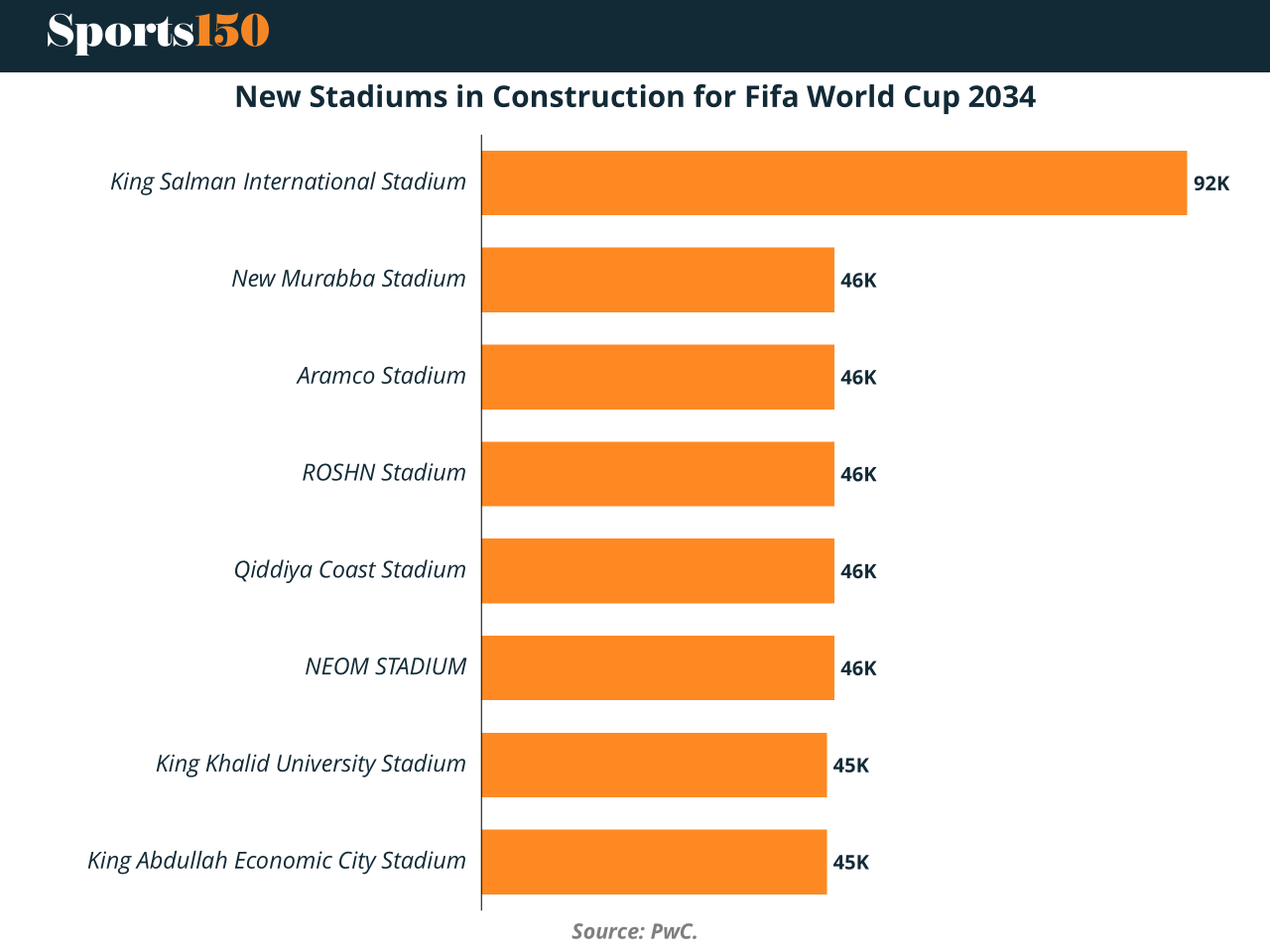
The first chart reflects the breadth of new stadium capacity being delivered across Saudi Arabia in preparation for the 2034 FIFA World Cup. Eight new stadium projects—led by the 92,000-seat King Salman International Stadium—demonstrate the Kingdom’s commitment to world-class infrastructure. Multiple 46,000-seat venues, such as the New Murabba Stadium, ROSHN Stadium, and Qiddiya Coast Stadium, complement these efforts and diversify the hosting footprint across Riyadh, Jeddah, Qiddiya, and NEOM. According to the digital stadiums analysis in the attached PDF (pages 2–7), these venues are being designed from the outset for high-performance functionality, sustainability, and fan-centric digital engagement.

The second chart highlights an equally important dimension: the long-term sports event pipeline stretching to 2034. This multi-year road map—from the 2026 World Endurance Championship to the 2029 Asian Winter Games—mirrors the Kingdom’s broader sports strategy documented in the PDF. As shown on page 3 of the PDF, Saudi Arabia’s event portfolio spans seven key sports, each providing opportunities for technology adoption, tourism activation, and economic impact.
Stadiums as Economic Catalysts and Community Anchors
Globally, sports venues have evolved from single-use arenas into multi-purpose entertainment destinations. Saudi Arabia is deploying a similar approach to maximize socioeconomic returns. The article provided describes how public-private partnerships can amplify the impact of stadium districts, citing examples such as Birmingham City’s Sports Quarter and the Tampa Bay Rays’ development pledges. Saudi Arabia’s model aligns with these themes: stadiums are envisioned not merely as matchday assets but as drivers of urban regeneration, community cohesion, and commercial diversification.
The PDF’s map of major Saudi stadium developments (page 5) complements this perspective by illustrating how new venues are geographically distributed to support regional development goals. Cities across the Kingdom—from Riyadh and Jeddah to NEOM and Qiddiya—are receiving upgraded or newly built sports facilities, many integrated with broader smart-city initiatives.
Digital Stadiums: Redefining the Fan and Operator Experience
The most consequential force reshaping the Kingdom’s sports facilities is the adoption of advanced digital technologies. According to the PDF’s sections on pages 4 and 8–12, digital stadiums enhance:
Fan engagement through personalized services, high-speed 5G connectivity, and interactive digital applications
Venue operations via IoT devices, AI-enabled crowd flow management, and predictive maintenance
Sustainability through smart lighting, automated energy management, and AI-driven HVAC optimization
Safety and security using facial recognition, drone surveillance, and cloud-based command centers
Saudi Arabia’s approach mirrors global best practices showcased in the PDF’s benchmarks of the 2022 Qatar World Cup, SoFi Stadium, and the Intuit Dome (pages 14–19). These venues demonstrate the power of digital twins, immersive AR overlays, autonomous robotics, and AI-enhanced experience management—technologies now planned for deployment across Saudi Arabia’s upcoming stadium portfolio.
Meeting Evolving Fan Expectations
Deloitte’s perspective on generational changes in sports consumption reinforces why Saudi Arabia is heavily investing in digital enhancements. Younger audiences expect shorter, more dynamic content, frictionless mobile services, and immersive experiences. The rise of “second-screen behaviors”—where fans interact with apps, stats, and social media while watching—requires stadiums to provide connectivity and content that match or exceed at-home entertainment.
The attached PDF underscores this trend on page 8, noting that 54% of Gen Z spend four or more hours daily on social platforms. Saudi Arabia’s stadium pipeline incorporates this reality through real-time digital services, AR visualizations, and personalized in-seat experiences. These investments ensure the Kingdom can capture and retain the attention of future generations of fans.
Enhancing Revenue Diversification
As highlighted in the source article, shifting revenue models are pushing sports organizations to reduce reliance on broadcasting income. Modern stadiums can act as powerful commercial engines through non-matchday events, premium hospitality, data-driven advertising, and immersive retail experiences.
Saudi Arabia is pursuing the same model. With eight new stadiums and multiple entertainment districts underway, the Kingdom is creating flexible venues capable of hosting concerts, esports, festivals, conventions, and year-round fan engagement activities. This aligns with case studies from Tottenham Hotspur and Real Madrid referenced in the article, where diversified stadium usage significantly expanded revenue.
A Future Defined by Technology, Inclusion, and Sustainability
The PDF’s concluding sections (pages 21–24) outline key considerations for Saudi Arabia’s stadium transformation, including standardization frameworks, inclusive digital design, scalable cloud infrastructure, and robust resiliency planning. These priorities reflect a forward-looking vision: to create global benchmark stadiums that deliver immersive, personalized fan experiences while advancing national sustainability and economic goals.
By integrating cutting-edge digital infrastructure, strategic event hosting, and community-driven venue development, Saudi Arabia is building not only new stadiums—but a future-ready sports ecosystem poised to redefine global standards.
Sources & References
Deloitte. (2024). Ambitious stadium projects aim to bridge public-private investment goals. https://www.deloitte.com/us/en/insights/industry/technology/technology-media-and-telecom-predictions/2025/tmt-predictions-sports-fan-experience-explodes-with-new-sports-infrastructure.html
PwC. (2024). Transforming sports and fan experiences with technology in Saudi Arabia. https://www.pwc.com/m1/en/publications/documents/2024/digital-stadiums-eng.pdf