- Sports 150
- Posts
- Immersive Infrastructure: How the A’s Are Selling Vegas Before It’s Built
Immersive Infrastructure: How the A’s Are Selling Vegas Before It’s Built
The Oakland A’s may be years away from opening day in Las Vegas, but the team is already hosting fans inside its new ballpark—virtually.

Eight miles from the construction site on the south end of the Strip, the A’s have opened a 3,500-cubic-foot Ballpark Experience Center—a high-tech, high-stakes investment in premium sales infrastructure. At the heart of it is the “Immersive Cube,” a six-sided digital chamber powered by 26 million pixels, Unity’s 3D engine, and Advent’s Experience Management System. There are no headsets. Just LED floors and walls that react to an iPad, transporting visitors from the owner’s suite to the pitcher’s mound with a few swipes.
This is not just a gimmick—it’s a conversion funnel. Built by experience design firm Advent, the Cube is a flexible storytelling platform where prospective buyers can visualize exactly where they’ll sit, host, and spend. Want a view from the outfield club seats? Tap. Curious about the proximity to private aviation routes? Tap again.
And in Vegas, optics matter. “There’s a certain wow factor that is required in here,” said John Downie, Advent’s SVP of Strategic Solutions. But the functionality is just as important. The Cube is “not on rails,” meaning it can adapt in real time to new renderings, customizations, or updated architectural models. That gives the sales team agility in a fluid build process.
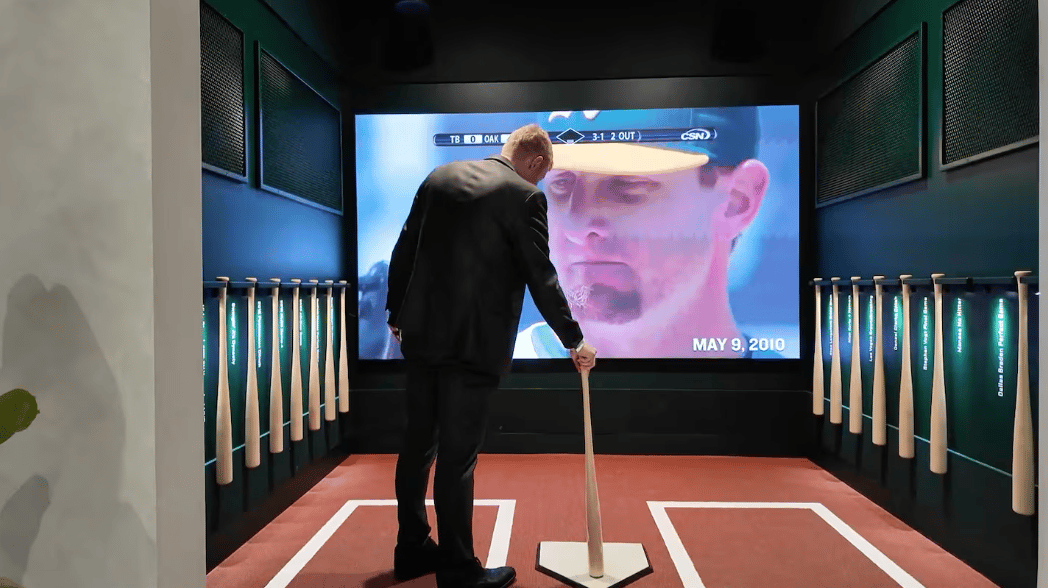
Beyond the Cube, the Center includes a bar, an event space, and a mini-theater wrapped around a digital “bat wall.” Pick up a bat labeled with an A’s legend—Dallas Braden, Rickey Henderson—and tap it against home plate to summon archival footage. It’s part museum, part sales tool, and fully engineered to convert interest into transactions.
This approach aligns with broader trends in sports real estate, where multi-use infrastructure must now sell itself long before gates open. With capital costs escalating and public funding more scrutinized, franchises need early commitments from local businesses, suite buyers, and sponsors. The A’s, who are trying to reestablish roots in a new market, are especially reliant on immersive tech to connect a storied past with a speculative future.
Why not wait until the stadium’s built? Because premium inventory is no longer sold—it’s pre-sold. In a world where sports hospitality is a seven-figure line item, experiences like the Cube offer a tactile, high-conviction pitch. You’re not just buying a seat. You’re buying a vision—and you can stand in it today.

Bottom line: The A’s are creating a template for how sports teams can use immersive infrastructure to drive monetization ahead of physical completion. As stadiums become more expensive and ticketing more data-driven, expect this kind of tech-enabled selling to become standard practice across leagues.
In the sports business, future revenue isn’t abstract anymore. It’s on display—and it's clickable.